Welcome, today I am posting another in my occasional series about architecture and style through the ages, taken from my assignment for the Interior Design course I completed last year. Today I have chosen the art deco style which was largely a very decadent time between the two world wars.
ART DECO
The Art Deco style was representative of the 1930s. However previous to this, and paving the way, came the Bauhaus movement and which brought with it a new style; The Bauhaus style, prevalent from 1919 to 1933, which was founded in Germany and was also known as the International style, and was marked by the absence of ornamentation and by the principal that ‘form follows function’ and ‘less is more’; harmony between the function of an object or a building and its design. It questioned the theories of craftsmanship versus mass production which had come before it, the relationship of usefulness and beauty and the practical purpose of formal beauty in a commonplace object. The style became one of the most influential sources of Modernist architecture and modern design.
Art Deco first appeared in France after an exhibition in 1925 and quickly captured the world’s imagination. It was an influential visual arts design style which flourished internationally in the 1930s and 1940s before its popularity waned after Word War II. Conversely the phrase ‘Art Deco’ was not coined until the 1960s. The design style encompassed everything from jewelry, art, ceramics, cinema, furniture and interior design as well as architecture itself. It is an eclectic style that combines traditional craft motifs with machine age imagery and materials. The style is often characterized by rich colors, bold geometric shapes, and lavish ornamentation. Art Deco emerged from the time intervening the war years when rapid industrialization was transforming culture. One of its major attributes was an embrace of technology. This distinguishes Deco from the organic motifs favoured by its predecessor art nouveau. During its heyday, Art Deco represented luxury, glamour, exuberance, and faith in social and technological progress. America, and in particular Hollywood embraced this new era. The austerities imposed by World War II caused Art Deco to decline in popularity: it was perceived by some as gaudy and inappropriately luxurious.
Each Country interpreted the architecture slightly differently but in essence Art Deco was a streamlined style and took inspiration from the age of the great Ocean Liners from the beginning of the 20th century. Art Deco was also known as Moderne, with an ‘e’ to differentiate it from more progressive modern architecture.
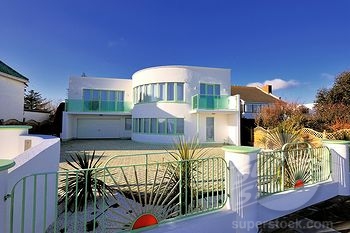
For my chosen image I have selected a property from Architect Oliver Hill who visualised a two hundred acre site in Frinton-on-Sea, Essex and an estate of more than 1000 art deco houses was planned. It was started in 1934 but was never completed and the development stopped in 1936. Co-incidentally he also designed The Midland Hotel on the North Coast which opened in 1933 and is another Art Deco gem.
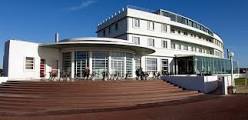
Art Deco emphasized geometric forms and shape: spheres, polygons, rectangles, zigzags, chevrons and sunburst motifs. Elements were often arranged in symmetrical patterns and modern materials such as aluminum, stainless steel, chrome and plastics were frequently used. Stained glass inlays and lacquer were also common. Colors tended to be bright and high-contrast.
The house has a very elegant look. The white, and quite often, box-like architecture with crisp horizontal lines, was broken by vertical columns and large windows and doors. As in this property where the walls were curved the windows would wrap around the curve. The windows were made of metal frames, with the first floor windows sitting directly over the ground floor and broken up into many panes. Art Deco doors were most typically partially paned with stained glass imagery of bold shapes and colours. In contrast the exterior walls were clad in white concrete or ‘snowcrete’, designed to reflect the sun and keep the inside cool. Long lines of windows were designed to let as much light into the house as possible. It was a feature that architects in 1934 recognized as ‘having a beneficial effect upon the health of the occupants’. The ‘best rooms’ previously at the front of the house were moved to the back away from the road. This increased privacy and also meant that best rooms would open onto the spacious garden. Chimneys much less prominent than in previous styles. In fact with a rounded parapet to hide any notation of pitch the properties often looked roofless from the front.
Flat concrete porches were often a feature together with balconies made from aluminum and large front gardens. This property has metal gates and railing with the much loved sunray design in a bright contrasting colour. The property was also built with a garage as Britain had begun its love affair with the motor vehicle.
I can see that this property has rhythm and repetition from the use of the balconies, (and the windows that stand behind them), that stand out on either side balancing out the rather heavily rounded right hand side. The use of the turquoise colour is then repeated in the gates and railings giving more emphasis to these features and drawing the eye in from the large sweeping garden or driveway. The rounded columns either side of the main gates are in harmony with the rounded section of the house and this is where the emphasis lies. Again the colour of the sunray is repeated in the front door to bring about a cohesive, rather beautiful and glamorous design.
Here are some more examples of art deco properties:


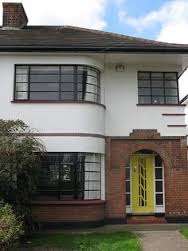
All images courtesy of google images
The furniture and accessories from this era have a certain glamorous status which is still very popular today and which can easily be accommodated in most modern settings. The examples below are rather luscious I hope you’ll agree:)


All images courtesy of google images
 pebblestoneliving.com