
This week is the first in a mini-series I shall scatter throughout the next few months taken from one of the assignments for my course all about architecture throughout the last 5 centuries. I am starting off with my favourite type of architecture from the Georgian period.
18TH CENTURY HOUSE
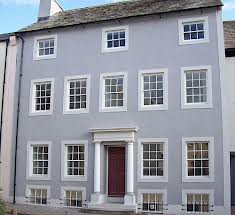
This large 18th Century town house is to be found on Queen Street in Whitehaven and is typical of houses in rows of terraces that were springing up all over the country during the 18th century.
By the early 18th century Europe was enjoying a period of relative peace and economic prosperity. Manufacturing output fuelled by technological innovation made Britain the world’s first urbanised and industrialised society. It was under this wealth of circumstances that groups of houses aligned side by side in rows first emerged. Later called terraces their appearance became synonymous with the four successive King Georges throughout the 18th Century.
However the architecture took influences from the late 17th century and spurred on by Inigo Jones and Palladianism, and the various European architectural books that were published the Georgian architects were producing buildings that followed these clean lines and symmetrically proportioned facades. It was also the first time that properties were built ‘double pile‘ which instead of arranging rooms side by side around a courtyard, rooms were built one behind one another, two deep, with access via an internal corridor, under a single roof. These homes were more compact, allowing for more to be built in the upcoming urbanized cities. This also reduced the amount of walls and roofing and therefore the roofs were designed in a ‘hipped’ style; the four sides slope to the exterior walls of the building rather than creating gables at either end as a pitched roof does and was essential in spanning the deeper double-pile layout. The neat rows of sash windows and regimented chimney stacks point towards a greater formality in outward appearance.
The windows were divided by thin, delicate wooden glazing bars. The windows of a Georgian property were always symmetrical and a dominant, elegant feature, but there was a fine balance between ‘a house of glass and a heap of brick’. The upper windows on many Georgian houses are smaller having only 6 panes as opposed to 12 on the lower floors. This was partly because these were usually only servants rooms, partially housed in the roof but also, from the street level, it has the perspective of actually making the building look taller. Front doors were usually solid and painted in dark colours. Most usually they were paneled (imitating panelling that was often found internally on walls) with brass wear centrally placed. Rows of terraces were mostly built of brick and were often rendered and had painted exteriors in an array of colours. Some terraces, in Brighton for instance, were stuccoed with a white facade, whilst others in East London for example, showed the original brick facade. However the infamous Royal Crescent in Bath was built in stone.
This house has a large central classical style doorway. It was quite usual to see steps leading up to the front door with a pedimented porch which would be composed of supporting turned posts or columns which support the architrave; the beam that rests horizontally across the top of the posts or columns. It could be said that Form not Function was the chief concern of the 18th Century architects and the Georgian period is said to have produced Classical architecture.
Servants rooms were often found in the attic or otherwise sharing the basement but these were often dark, damp places usually noted for storing food and cooking. In an effort to allow natural light into the lower levels of the building the terrace was set back from the street set back behind neat rows of iron railings. Access to the ground floor was by a series of steps. It stems from Palladianism that the most beautiful features of a building should be placed most in view; and those of a plainer kind should be concealed from sight as much as possible.
This house has proportion and scale in varying degrees. The pitch of the roof is small in relation to the height of the building. The top windows are again small in scale to the other windows which are all of equal size. Due to the number of windows this is where the emphasis of this property lies and gives it rhythm and repetition and a harmonious feel. The front door stands out with its large columns particularly with the door being painted in a contrasting colour. For me this is my favourite period of architecture which I find very pleasing to the eye.
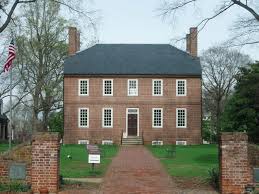
I have added below lots of lovely pictures from the era, including exterior and interior shots:


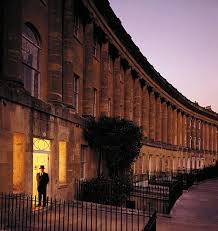
Images via Google Images
 pebblestoneliving.com